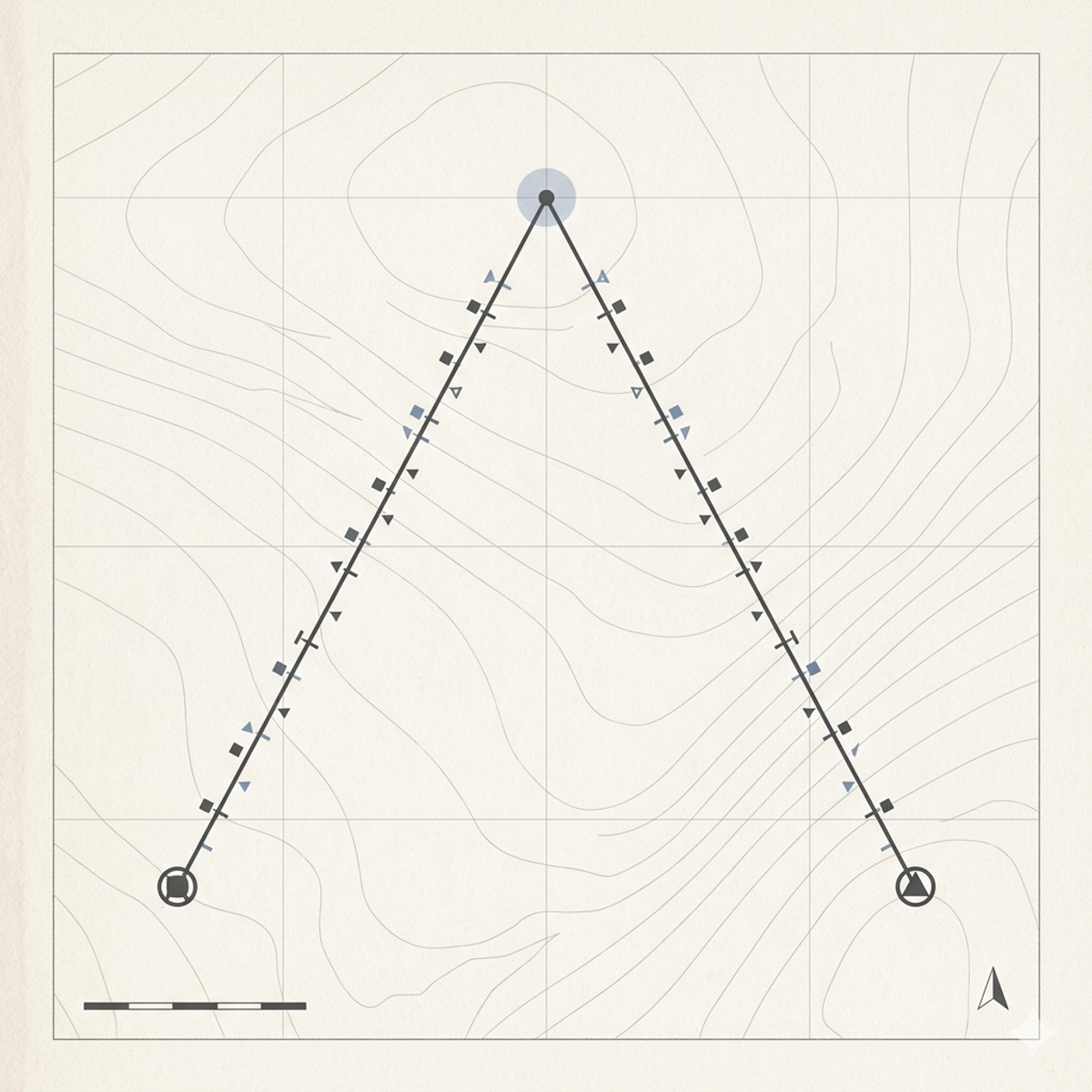
Two AI systems. The same web. Completely different answers.
That is not a bug. It is a structural property of how AI search works and most people building on top of it have not yet reckoned with what it means.
We noticed it while building research tools in production. AI-augmented search was returning materially different results from direct API calls to the same underlying search engine. So we ran a controlled study to measure it.
Fifteen queries. Three categories: general knowledge, brand intelligence and UK regulatory. We compared what Claude cited with what a direct Brave Search API call returned for the same queries. The headline finding: 38% overlap. Nearly two thirds of what Claude surfaced did not appear in Brave's top-10 results for the same query at all.
This divergence is not random. It correlates with query complexity. For a simple market-sizing question, both systems returned 80% of the same sources. For a competitive analysis requiring synthesis across multiple domains, overlap dropped below 30%. The more a query requires judgement, the further the two systems drift apart.
The mechanism behind it is query reformulation. Before searching, Claude rewrote 87% of queries adding temporal specificity, decomposing compound questions into focused sub-searches, varying terminology. The reformulation is genuinely useful. It surfaces sources a direct search misses. But it also means two people asking the same question through different AI systems are, in practice, consulting different bodies of evidence.
That matters because of what AI search has become. It no longer returns a list of results for a person to evaluate. It synthesises those results into a conclusion. The user receives the answer, not the evidence. The sources are invisible. And right now, there is no standardised way for any AI system to know whether a given source actually merits the trust being implicitly placed in it.
Web content is not produced to be accurate. It is produced to be found. The economics of SEO and digital publishing have created an environment where findability and reliability are entirely independent of each other. AI agents have inherited that misalignment.
We think there is a way to address it.
The AI Trust Index (ATI) is a proposed open certification standard for web content designed for AI consumption. Rather than assessing whether individual pieces of content are correct, ATI certifies the publishing entity: that it is a real, accountable legal entity with named authors, a published editorial policy and a correction mechanism. Certification is expressed as a cryptographically signed, machine-readable trust token that any AI agent or browser can verify in real time.
Three tiers. ATI-1 for verified identity. ATI-2 for editorial accountability. ATI-3 for independently audited processes. The governance model draws on the Certificate Authority structure that underpins SSL and the independent assessor model used by B Corp.
ATI does not guarantee accuracy. It guarantees that when a certified source gets something wrong, processes exist to identify and correct it. That is a trust floor, not a quality ceiling. It is infrastructure, not a judgement.
The web is becoming the evidence base for AI reasoning at a civilisational scale. The infrastructure to support that function does not yet exist. We think it needs to.
The full white paper sets out the empirical evidence, the framework in detail, the governance model and the limitations we think need to be addressed before this could be implemented at scale. We are publishing it as a starting point for a conversation, not a finished proposal. We would welcome challenge, collaboration and critique.